


 |
| Sustainability in Taitung's DNA: From Festivals to Everyday Life |
|
While the world rushes to find answers for coexisting with nature, Taitung has long been crafting its own response on this pristine land between mountains and sea, moving at its own pace. In 2026, we place "sustainability" at the core as we reimagine the vitality of this city — from low-carbon transportation networks, to the creative reuse of discarded resources, to the social mobility brought by digital nomads and corporate retreats. This series of articles invites you to see how Taitung transforms "slow" into resilience that protects the land, turning every event, every journey, and even every policy into a way of caring for this land. Join us as we discover how this city treads lightly toward a sustainable future in harmony with the planet. TAITUNG'S SUSTAINABILITY ROOTS,
SEEN THROUGH THE SLOW FOOD FESTIVAL 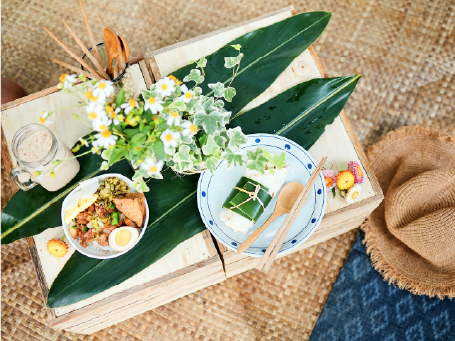 Taitung's sustainability efforts did not begin with slogans — they are rooted in a food culture born from the land itself. The Taitung Slow Food Festival is the clearest example of turning sustainable values into concrete action. Through its field to table approach, the festival champions local production and local consumption, drastically shortening food miles to reduce carbon footprints while promoting indigenous crop varieties to protect biodiversity. What food lovers remember most is the festival's strict ban on single-use tableware, encouraging the use of natural materials — such as shell ginger leaves and betel nut sheaths — as serving vessels, fully realizing a zero-waste vision. This "slow economy" — grounded in respect for the land and a commitment to long-term balance — has become the cornerstone of Taitung’s sustainability strategy. THE EXPO'S GREEN TRANSFORMATION:
ECO-FRIENDLY ARCHITECTURE AND OLD TOWN STROLLS 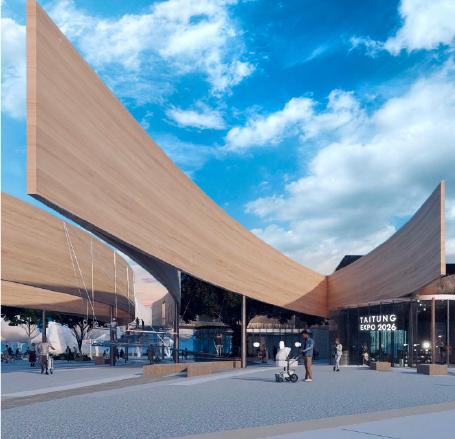 With the launch of the 2026 Taitung Expo, this sustainability mindset extends further into the city's built environment. The Showcase Project, one of the Expo's main venues, embeds environmental responsibility into its design. The building's exterior uses Glued Laminated Timber (GLT) — an eco-friendly engineered wood made from multiple bonded layers that is lighter and stronger than conventional reinforced concrete, while effectively sequestering carbon and significantly reducing emissions. To minimize disruption to the surrounding community, construction follows an off-site prefabrication and on-site crane assembly model, improving efficiency while reducing disturbance to nearby residents and the environment. Construction is well underway. Once completed, beyond serving the Expo, the venue will invite local teams and young creators to participate in programming and curation, ensuring the space is not simply a government-built structure but a living environment shaped and shared by the community. 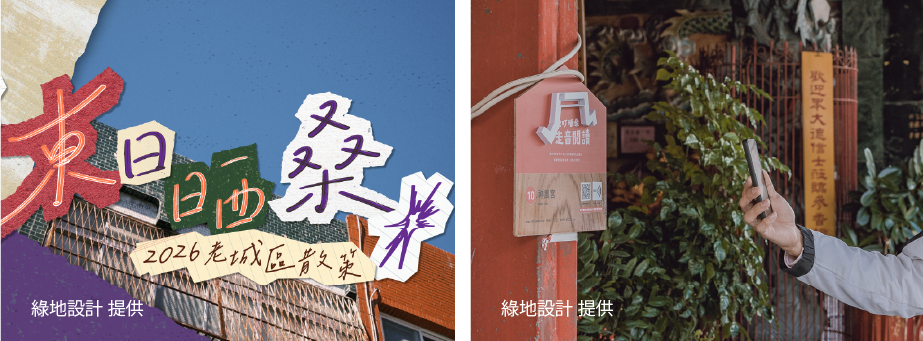 Meanwhile, the Taitung Go Sun old town walking project offers a new model for low-carbon urban exploration. Centered on cultural heritage, the project replaces printed materials with smartphone-based guides, directing visitors to explore alleyways on foot or by shared bicycle. This low-impact design approach not only cuts resource waste but lets travelers connect more deeply with the old town through unhurried movement. The result is an urban experience where environmental care and cultural preservation go hand in hand. A SECOND LIFE IN THE SKY:
THE REBIRTH OF HOT AIR BALLOON FABRIC 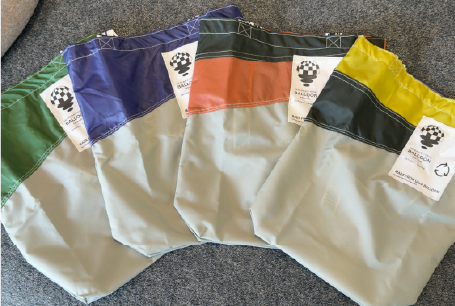 Taitung's most iconic event, the Taiwan International Balloon Festival, has also developed a remarkably creative circular economy pathway. When balloons like Taitung-1 are retired from flight, they are not discarded. Instead, through design innovation, the balloon fabric is transformed into sustainable souvenirs such as lightweight carry bags. The polyester or nylon fabric used in balloon envelopes is light, strong, tear-resistant, and heat-tolerant — ideal properties for durable bags. Printed with the words "MADE FROM USED BALLOON," these products not only extend the lifespan of flight materials but transform the mountain imagery that once floated across the sky into a sustainability story visitors can carry home. SUSTAINABILITY SPREADS:
THE GRASSROOTS REVOLUTION OF "TRASH⁺ LAB" 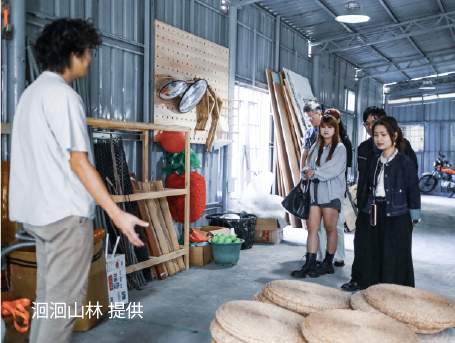 In Taitung, this sustainability momentum has also reached the private sector. TRASH⁺ LAB, initiated by Taitung’s own Return Mountain Design, is a pioneer in this space. Facing the thousands of cubic meters of wooden waste generated annually by Taitung's medium and large-scale events, the lab established a "local material circulation system" that recovers, sorts, and digitally catalogs resources of which 40% would otherwise end up in landfill. 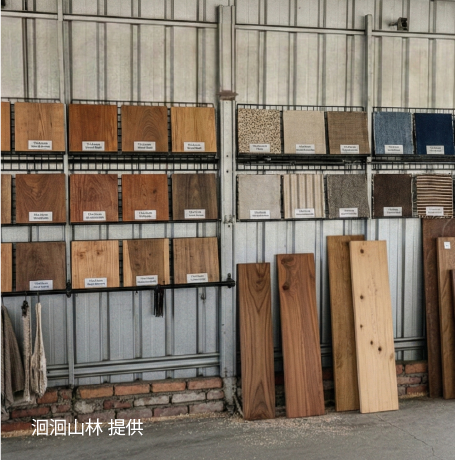 The system offers six categories of items — including exhibition structures and furniture — available for rental, with carbon footprint visualization tools that allow designers to see their emissions reductions at a glance. Taking events like the Get Away Festival as an example, renting instead of purchasing saves an average of 80% in production costs per event. To date, the system has prevented over 2.3 tonnes of carbon emissions. This model successfully transforms unwanted items into valuable resources, solving the persistent pain points of storage and waste in the exhibition industry. DECODING THE FOREST'S ESSENCE:
FULL-MATERIAL UTILIZATION AND CIRCULARITY  While grassroots labs work to give discarded wood a second life, the Taitung branch of the Forestry and Nature Conservation Agency and local brand GRANGE Taiwan have turned their attention to the mountains, launching a sustainability initiative rooted in scent. The "Decoding the Forest" essential oil series, developed through long-term collaboration, is built on the core principles of full-material utilization and circular economy. Branches and leaves from thinning operations in managed forests — material that would otherwise require separate disposal — are converted into locally sourced essential oil ingredients, turning waste directly into raw material and giving forest resources new purpose. This forest-born sustainability achievement is produced entirely in Taitung, from raw material supply through to finished product, creating local employment while significantly reducing carbon footprints by shortening transportation distances. In terms of craft, the essential oils contain no synthetic fragrances, and the plant residue left after extraction is returned to farms as cultivation material, completing a true cycle of resource sustainability. Additionally, a forest scent database built through collaboration among government, academia, and industry captures and catalogues the unique forest scents of the region, preserving these olfactory memories. The Taitung County Government has already introduced these essential oils into public spaces for ambient scenting, offering residents and visitors a subtle reminder of the forest's value whenever they step into county offices. SUSTAINABILITY IS NOT A SLOGAN
— IT'S TAITUNG'S EVERYDAY DESIGN From every Slow Food Festival, to the architecture of an Expo venue, to grassroots waste-reuse labs and forest resource development, Taitung demonstrates that design itself is sustainability in action. Through material rebirth, technological empowerment, and business model innovation, Taitung has successfully transformed sustainability into a daily experience you can touch, taste, and see for its beauty. As the core philosophy of TRASH⁺ LAB puts it: "Sustainability in Taitung means adding a little design to waste — every day." Taitung is building, with forward-looking vision, a beautiful city that coexists with its environment and thrives alongside its culture. |
| © TAITUNG COUNTY GOVERNMENT 2026 |

【Scheduled Maintenance Notice】
Our website and system services will be temporarily unavailable due to power inspection and network equipment maintenance.
Date & Time:
Sat, Oct 17, 08:30–13:00 (GMT+8)
Services will be restored gradually after maintenance is completed.
We apologize for any inconvenience.
